Friday, May 11, 2012

Mayday


Where have all the Right Hand Gloves Gone?
Can’t you hear Peter Paul and Mary singing?  Seriously.  Where are they?  Every May I undertake the big winter clothing to summer clothing switcheroo.  And every year it’s the same mystery.  The winter season leaves us with a pile of left handed gloves.  This year there are 12 orphan gloves.  I gave the family 24 hours to locate the gloves’ partners and then off to the trash bin they go. But not really. It is merely a threat. I bag them and put them in the winter outerwear box snuggled next to the gloves with partners.  I am secretly hoping that at least half the gloves’ mates will be discovered in summer.  Where will they come from?  A glove or two is usually mined from the hayloft when we put in summer hay.  A glove or two is unearthed from the mud or found hung on a gate or in the middle of a field, dragged off by our dog Tony.  And the right hand glove is always missing because “they” (not me -  I shove mine in my pocket) take off the right hand glove to open a door, undo a latch, untie baling twine, use a knife.  Tony contributes to the glove disappearance.  Tony has a shoe, glove, hat, boot fetish. He steals clothing from the mud room or anywhere we discard our clothes or shoes and hoards the stolen goods in a pile – usually next to the fire. He covets them, guards them and won’t let us have them back without a fight or at least a bribe. In the summer, his trove is harder to find. He often secures a lair in the high grass in the back pasture to stash garden gloves, flip flops, rubber boots, bandanas and sun hats. The mower usually finds them before we do.  We need to borrow a hunting dog to do weekly recons and lead us to Tony’s treasure.  
Winter's Left Handed Glove Leftovers

Thursdays are Chicken Slaughter
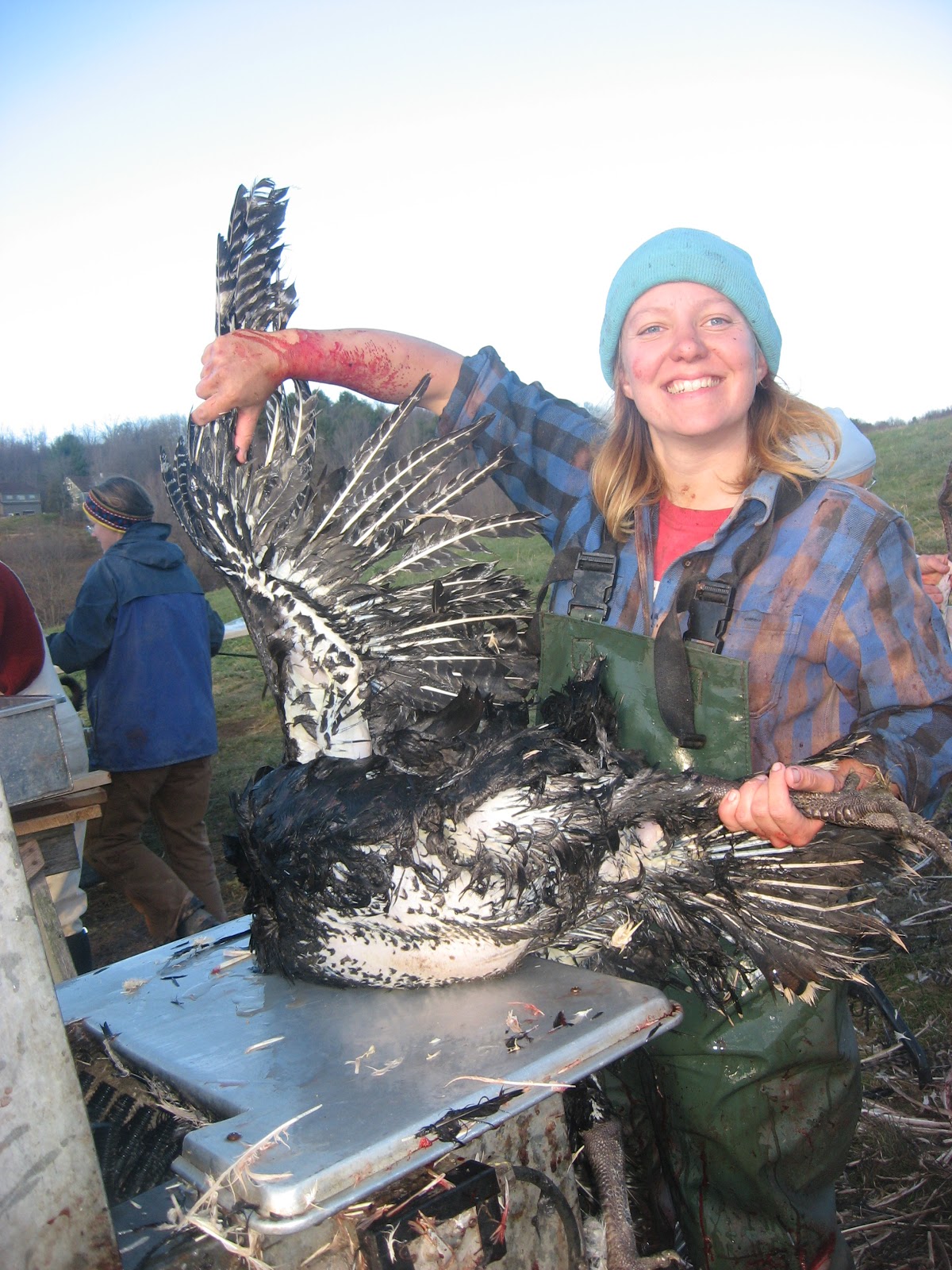
The first slaughter of the season took place on Thursday and will every Thursday until November. We slaughtered thirty of the biggest chickens to take to the farmers market on Saturday.  Many folks get squeamish when we use the word slaughter and in the past I used euphemisms such as harvest or glean. No more. It is what it is. We raise chickens on pasture and give them a good healthy eight week life and then we kill them so we can eat them and so our customers can eat them.  I can envision all the PETAites rolling up their sleeves.  I respect people who have strong convictions and principles. I really do. I respect people who don’t eat meat and if they do eat meat, choose to eat meat that has a traceable history and lived a life they can celebrate and a death they can condone.  I have little patience for hypocrites - vegans or vegetarians who rant about killing sentient beings as they stand tall in their leather sandals, their jeans hiked up with a leather belt and and a quarter of a cow hide purse slung over their shoulder to tote around their “essentials” – cell phones, ipads, Smartphones. 

So slaughtering chickens for me is an execution (pardon the pun) of my beliefs. I believe that animals raised for food on our farm are born with a destiny and it is our responsibility to make sure that the life they live is as close to possible as a nature would provide (without the natural predators and allowing a chicken be a chicken roaming in the grass pecking for bugs). And it is our responsibility to make sure that their death is decent – quick, decisive and without fuss. I’ll go one more step – it is our responsibility to use the whole animal and not to waste a shred of meat, bone or hide.  If we take, we must use wholly and responsibly.  And best of all the chickens we raise and slaughter are delicious.   Many of you know that I won’t eat meat unless it is raised on our farm. When I eat our chickens, I am celebrating nature and the chicken's destiny with every bite.

Susannah Plucking Chickens

Tom Eviscerating a Chicken
Comfrey in the Herb Garden
King  Comfrey
I wish comfrey would stay dwarf sized in my garden. Unless I prune it severely and feed the leaves to the goats, rabbits and pigs on a regular basis, it quickly overtakes the herb garden and reigns as dictator until the last frost.  I use comfrey as a serving platter for cheese and hors d’oeuvres.    My goal this summer is to find a way to weave comfrey into some recipes. Any ideas?   

Palette versus Palate
Shelves in our Farm Store
Pate de Campagne 
Pork Rillette
Pickled Ramps, Ramp Pesto and Bacon Marmalade
We attended Foodfest in Callicoon last Saturday.  One customer, wearing a “Life is better with Bacon” t- shirt, bought most of my bacon marmalade and bacon brittle.  The pate de campagne and the pork rillette was a big hit.  My favorite is the ramp pesto- the first pesto of the season. I look forward to all the different pestos I will make this summer to celebrate the season – green pea pesto, garlic scape pesto, three basil pesto, cilantro pesto.   I am fascinated with the color and flavor of food and how they compliment and contrast when we taste.  When I was in art school, I had very little “artistic talent” but I had an innate way of visualizing a color (the sky under morning mist for example) and then recreating the color on my palette.   My art teacher hired me to mix paints for him.  I use the same method with food.  As I was feeding my rabbits this morning, I was thinking about rabbits and Peter Cottontail and blackberries and why the sage did not overwinter this year and I ran the flavors of blackberries and sage through my mind and created a blackberry glaze with sage for spare ribs.  As often happens, I googled blackberries and sage and voila  - a recipe for blackberry sage sauce for meat. As suspected, there are very few new recipes – it’s how they are executed.   I am making bacon marmalade this afternoon.  I usually add water to thin it before canning but decided to use the last of the orange juice.  I bet that adding cherry juice or a sprinkle of shaved chocolate would have tasted even better.  Guess I've traded my palette for a palate.

Rampage
Ramp Butter

Pickled Ramps
The pickled ramps, ramp pesto and ramp butter celebrate ramp (wild leek) season. We have one more week of digging ramps.  While I read a lot about the over harvesting of ramps, ramps carpet our woods. There are ramps growing as far as we can see.  Thinning the ramps by digging the whole plant, helps the ramps spread and grow thicker in bulb and stem.  We sell fresh dug ramps at the farmers markets and ramp pesto, butter and pickled ramps. Do you have a recipe for ramps?

May Day May Day
When I think about how busy our family is about to get, I want to shout an SOS.  We are doing five farmers markets this year, two more than last year.   All of the markets start May 19th.   I feel like Patton comandeering Team Farmers Market. Every Stone & Thistler is assigned a market. Every market has a utility box and a check list.   We are opening Fable only two or three times a month to accommodate our expanded farmers market schedule. Add Fable, the b & b and Farmhand's Cabin, the building of the creamery and oh yes farming to our schedule and you’ll understand our plea of SOS.  But we do what we have to do so we can afford to pay the mortgage and heat the house during the winter – neither of which we did very well this winter.   While I would love to stay home and tend the fires and cook in them, as a member of Team Farmers Market, I will be hitting the streets with my table, banner and box and coolers of meat.   Please see our website www.stoneandthistlefarm.com for the dates Fable will be open for Saturday dining and brunch and for the farmers markets in which we will participate his season.

Stone & Thistle Farm, Fable and Kortright Creek Creamery are on Facebook.  Visit us there for more frequent updates.  Enjoy the advent of summer as it brings lilacs, baby animals, garden delights, warm rains and lots of sunshine.

Friday, March 16, 2012

March Madness (and I am not talking basketball!)

Springing into early Spring

March is usually the most depressing month of the year because we are plagued with all weather - ice, snow, rain, sleet, damp, cold, mud and high winds. This year March came in like a lamb and remains a lamb. We have high hopes that the lamb won’t morph into a lion by the end of the month. Kidding season began two weeks ago. Normally the freezing temperatures create challenges for just born kids. The 50 degree temperatures are good for us and good for the kids. We bred 20 ewes this year so we would have lamb for the farmers markets in May and June. The lambs and kids have commandeered the barn. In early morning the kids race up and down the hillside, the lambs gambol out to the sun. They run, leap, prong and then stop and cry for their moms. Their moms answer back. Each baby finds their mom, take a mid morning bump at the udder and then bellies full, crash. Some of the does are milk bars – they don’t care who nurses from them so some of the kid entrepreneurs run around nursing from every mom before they nap. Their favorite snuggle spots are the door outside the barn in the sun and the alleyway.


Kid Sunning in the Barnyard


Hey I've got Hay

Kid Cache
Too early to Plant the Peas?
The warm weather lures us outside to clean up the pastures, yards and barns. We are discovering right handed gloves, pocket knives, piles of baling twine, haylage wrap, turkey slaughter debris, garbage and whatever the melted snow left behind. I want to start the gardens but the soil is too wet. And I don’t want to uncover all of the perennial herbs because they may need protection if the March Lion visits. I planted peas in June last year and my family told me I was wasting my time. But I had spent so much time building a stick and twine fence that I was determined to use it for peas. And they were right; the peas grew three or four inches and then wilted in the heat. Tom ripped down the stick fence in the fall and is putting up a traditional chicken wire fence with stakes for the peas. Yuk.


Last Year's Pea Fence
The Geography of Convenience

We are planning our summer season which includes applying for urban farmers markets. We attended a Community Markets mandatory farmers market meeting this week in Rhinecliff. The venue had a wonderful view of the Hudson River so when I wasn’t interested in the discussion, I enjoyed watching the tug boats bring barges up and down the river. We currently do one winter market in Mamaroneck on Saturdays. We get up at 4 am and head four hours to Westchester. My favorite part of the trip is the Tappan Zee Bridge and the view of the Hudson River from midbridge. We may be doing a summer market in Westchester and in Brooklyn because sales at our local farmers markets have been disappointing over the past two years. Do we sell at city based markets, make three times as much money but incur three times as much time and expenses doing them? Or do we stick with our local markets and hope they improve? The bottom line is that the opportunities are greater downstate. The downstate markets offer more customers in a higher income bracket and more customers who are willing to allocate a larger percentage of their hard earned money on good food. Over the past two years, many local markets have popped up. The increase in farmers markets is convenient for customers but bad for vendors. There is a limited customer base, and it is not growing. There are 15 farmer's markets in the Delaware County/Otsego county area. Ten years ago there were three. This proliferation has diluted attendance at the larger markets. These markets are just splitting a finite customer base into smaller and smaller pieces. In fact, we could argue that if we sold at two local farmers markets on a Saturday we would be competing against ourselves. We understand the geography of convenience, especially as gas prices sky rocket, but we hope that consumers will drive out of the way to shop at the farmers markets, even if it is not enroute to their children’s soccer game or the dry cleaners. So the challenge for farmers market managers is to secure many vendors selling a wide variety of products or it is not worth the customers trip “out of the way”. Not an easy task. There are many challenges for small farmers who want to sell their products at a market – all having to do with regulations that are hard to understand and expensive – labeling, insurance, compliance, etc. Gone are the days when grandma could sell her peaches and peach jam at a stall at a farmers market.

As more small farmers conquer the ag and markets regulations and make their way into the farmers markets, consumers have more choices. Unlike the grocery store, the farmers market features a farmer behind the table. We don’t have to get all of the information we need from the label; we can have a conversation with the farmer. And the farmer has the responsibility of communicating truthfully and candidly with the customer. For example, our chickens are more expensive than other chickens at the farmers market. Why are our chickens better? How do we communicate that our broiler chickens are better for us and the environment because they roam pastures and woods without slamming the farmer down the aisle who raises his chickens in large indoor sunless houses? Signs, photos and conversations. But ultimately taste. Once the customer eats one of our chickens, he is a loyal customer, even at a higher price. We enjoy doing farmers markets because of the relationships we establish with our customers. When a customer tells us that the pork chops we sold them last week was the best they ever had, the four hour drive seems worth it.

Why No Lamb at Easter?

A week or two before Passover or Easter our farm phone rings incessantly with customers inquiring about lamb for the holiday. We lamb in February and again in May so unless you are interested in eating a new spring, 15 lb lamb and roasting it whole (as many of our Italian and Greek customers do) retail cuts of lamb, such as a leg of lamb, won’t be available for Easter. In the grocery stores, there is plenty of lamb for Easter and Passover because it comes from New Zealand. It is autumn in New Zealand and lamb is plentiful after a six-month growing season on summer pastures. I thought that the New Zealand and Australian Agricultural Council was behind the American tradition of lamb at Easter but discovered that the tradition relates to the first Passover of the Jews. The sacrificial lamb was roasted and eaten, together with unleavened bread and bitter herbs in hopes that the angel of God would pass over their homes and bring no harm. As Hebrews converted to Christianity, they may have brought their traditions with them. The Christians often refer to Jesus as The Lamb of God. The traditions merged.

Smoked ham is also a traditional Easter food. In the early days, meat was slaughtered in the fall. There was no refrigeration, and the fresh pork that wasn't consumed during the winter months before Lent, was cured for spring. The curing process took a long time, and the first hams were ready around the time Easter rolled around. Thus, ham was a natural choice for the celebratory Easter dinner. We have plenty of smoked hams. So pass on the New Zealand lamb and go for a smoked ham this Easter.

Newborn lamb
March Madness

Because it has been so warm, we bred all of the female rabbits this week. I used a new young buck and he seemed to do his job but the proof is in the kits. The gestation period is 30 or so days so if the buck successfully bred them, we will have kits by early April. If the weather is still warm by then we won’t have too much of a problem. One or two of the does are young so we will have to see what kind of moms they are. We culled the doe last year who refused to feed her kits or did not have enough milk. I gave her two chances but she managed to neglect the litters both times. I replaced her with a doe who is very skittish. I pet her everyday when I feed her fresh hay but she remains terrified of me and her surroundings. I make sure that she has lots of hay in her hutch and she spends most of the day buried in it. Of course, the border collies don’t help the situation. Every morning when they are let out of their kennels, they immediately run under the rabbit hutches and stalk the rabbits. The other rabbits ignore their probing noses but this young doe hasn’t figured out that the dogs can’t hurt her through the wire cage. Yelling at the border collies does not work – they are transfixed by the rabbits. They would spend all day watching rabbit TV if we let them. What’s truly madness in March is that the temperature is supposed to top 80 degrees next week!

Iron Rabbit with Tulips

Iron Rabbit

Saturday, January 21, 2012

A Ribbon of Coincidences or Are the Planets Aligned?

(Painting of East Hill by Richard Kathmann)

The Book of Job
Who laid the cornerstone thereof when the morning stars sang together and all the sons of God shouted for joy? Job 39:7


We saw the movie, Tree of Life starring Brad Pitt and Sean Penn. Stunning visuals. Minimal Dialogue. We loved it but one reviewer said if he could get one person NOT to see the movie, he would have accomplished something. The film is peppered with passages from the Book of Job. Poetry. I wanted to reread the passages, but we don’t own a bible. The next morning I was having breakfast with my elderly neighbor who is an avid bible reader. I mentioned the passage and she turned to it immediately in her bible. We read the Book of Job and marveled at the descriptions of nature and beauty. While I was cleaning the bed & breakfast that afternoon, I pried open a dresser drawer that had been stuck for years. Tucked in the corner was a bible.

Hast thou entered into the treasures of the snow? Or hast thou seen the treasures of the hail? Job 38:22
Moonrise over Winter Pasture

The Trick is the Water
I bought a pasta maker last year and have since abandoned it because I can't get the dough the right consistency to pass through the press. The dough sticks and clogs the machine. Every Saturday we sell our meats and Fable's Kitchen goods at the Mamaroneck Indoor Farmers Market. Three of the 20 vendors are pasta makers. During the slow moments, I asked them how to make the dough. The trick is the water. You have to use warm water although they offered no scientific explanation for it. I unstowed the pasta maker and made ribbons of wheat pasta mixed with the Sarah Palin (our turkey sausage). Last week I helped a fellow timebanker to write a business plan for heirloom masa harina that they grow, harvest and grind. She gave me two packages of masa. I spent three hours trying to make tortillas without a tortilla press. I have memories of walking through the markets in Mexico and hearing the rhythmic pat pat pat of the tortilla makers. My pat pat pat was not working and the result was disaster. The masa stuck to the plastic sheets. We hosted a time bank orientation and pot luck last Sunday. Over 35 people showed up to learn how they can use a time bank instead of money for services they need – house cleaning, babysitting, editing, automechanics, etc. (www.catskillstime.org) Trevor Wilson, the creator of Hard Pan Masa, offered to show me how to make tortillas without a tortilla press. We used two cutting boards, two pieces of plastic. The trick is guess what? Water. Warm water. I am now the tortilla queen. Made stacks of heirloom blue corn tortillas. There is no stopping me now. Now I need to learn how to make a killer Margarita? Anyone volunteering to teach me? Perhaps we can timebank it?

Corn Tortillas 


Ducks

A friend from Normany sent me a recipe for Calvados Cake. The recipe requires duck eggs. Two chicken eggs does not equal one duck egg. I tried. The cake was too dense. I gave up on my search for duck eggs and abandoned the recipe. This week a friend asked us to give his two female ducks a home. This morning there were two duck eggs in the nest.  Calvados Cake is back on the menu.

Mallard Cross Duck Lays Blue Green Eggs

Grand Jury Duty
I am a grand juror. The job of the 23 member jury is to determine whether the evidence presented by the prosecuting attorney is sufficient enough for the accused to be indicted. A recent case involved illegal possession of marijuana. Did you know that possession of over 16 ounces of marijuana is illegal? And if your marijuana plants are seized they are brought to headquarters and hung upside down in a drying room and months later gleaned. Yes, there is a person who has the job title of marijuana gleaner. The gleaned and dried marijuana is weighed and bagged. If the plants yield more than 16 ounces then you are in big trouble. This week I was listening to radio interview on NPR with Heather Donahue. She wrote Growgirl - How my life after The Blair Witch Project went to Pot. It is a book about the profession of growing medical marijuana. I learned a lot about growing marijuana. As a result of the broadcast, I offered a wealth of knowledge about growing, harvesting, male versus female plants, seeds, etc., during deliberations. My attempts to explain my in-depth knowledge of marijuana farming was shrugged off. When I show up next week, they will just think of me as the pot head in the corner.  At least I have all my teeth. 

The ribbon continues to unfurl with coincidences related to cardoon, green eggs, bundt cake, Delaware Valley College, black pigs, yarn and zippers.  The planets are on a roll. I think it's the right time to buy a lottery ticket.


Wrap Up
The next three months present the biggest challenge of beating that cold and winning the farming in the winter game. Lambing (although only 20 ewes) and kidding begins in a couple of weeks. We are ready this year with lambing jugs and watching for ewes bagging up. The dairy does are in good health and with any luck they will freshen with ease. We hope and pray that we do not lose any does this year from difficult freshenings.


The last belts of cold insured safe skating on the pond. Without sufficient snow for snow shoeing, cross country skiing, our Friday night ski, eat and sauna may have to be a bonfire and skating under the stars. Not a bad way to spend January and February.

Come on out! The store is open and the freezers are packed with cuts of pork, chicken, smoked meats and specialty sausage. The Sarah Palin (turkey, cherries and spices) is on the shelf again and we brought back the George Clooney (goat, pork, spices). Ground beef will be available by mid February or earlier.

Wrap up.  Stay warm.


Wednesday, December 28, 2011

Throw Away the Key

We are looking forward to booting 2011 out the door and throwing away the key. I am also asking the powers that be to pretty please bring more good than bad in 2012.


2011
January: Good - Granddaughter Catalina Breeze born. Bad: Monster snowstorm  February: Good - Oldest son Riley home from the army to see his new daughter. Bad - Surprise lambings in bitter cold. Lamb losses and LGD attack March: Good – 75 healthy kid goats born Bad – lose two excellent milkers from difficult freshenings April: Good - Montecello, Kate’s horse from Welwyn, arrives for R&R from a jumping injury. Bad - Cannot find a creamery to bottle our milk and make our yogurt – creamery building delayed because of finances May: Good - Invited to present at the inaugural Slow Money Conference in NYC and new intern arrives. Bad – farmers market sales affected by bad economy June: Good - Kate is accepted for the Equine Management program at Delaware Valley College in Doylestown, PA. Bad – have to borrow money to pay for Kate’s college July: Good – enjoying many guests at the farm stay and Fable is booked solid for Saturday dining and Sunday brunches Bad - The calm before the storm   August: Good – Neighbors. Bad - Hurricane Irene and no electricity for five days. Lost hundreds of turkey poults. September: Good – garden harvest is abundant. Farmers market sales pick up. Bad - Storm flooding causes severe damage along streams and roads. Farmers market sales plummet again. Family crises begin. October: Good – Warm autumn. Still picking and canning tomatoes. Bad - Family crises November: Good – great weather and crew for turkey slaughter Bad – Continued family crises December: Good – Kate home from college for the holidays. 2011 almost over. Bad - family issues escalate

Moonfall over Horse Pasture


Newborn Catalina snoozing

Montecello "Monty" arrives

Easter

The Rabbit Fleet
Slaughtering Easter lambsShane becomes Monty's groom


Letting Broiler Chickens out of Night Cabin
View of Farm from Uppper Pasture

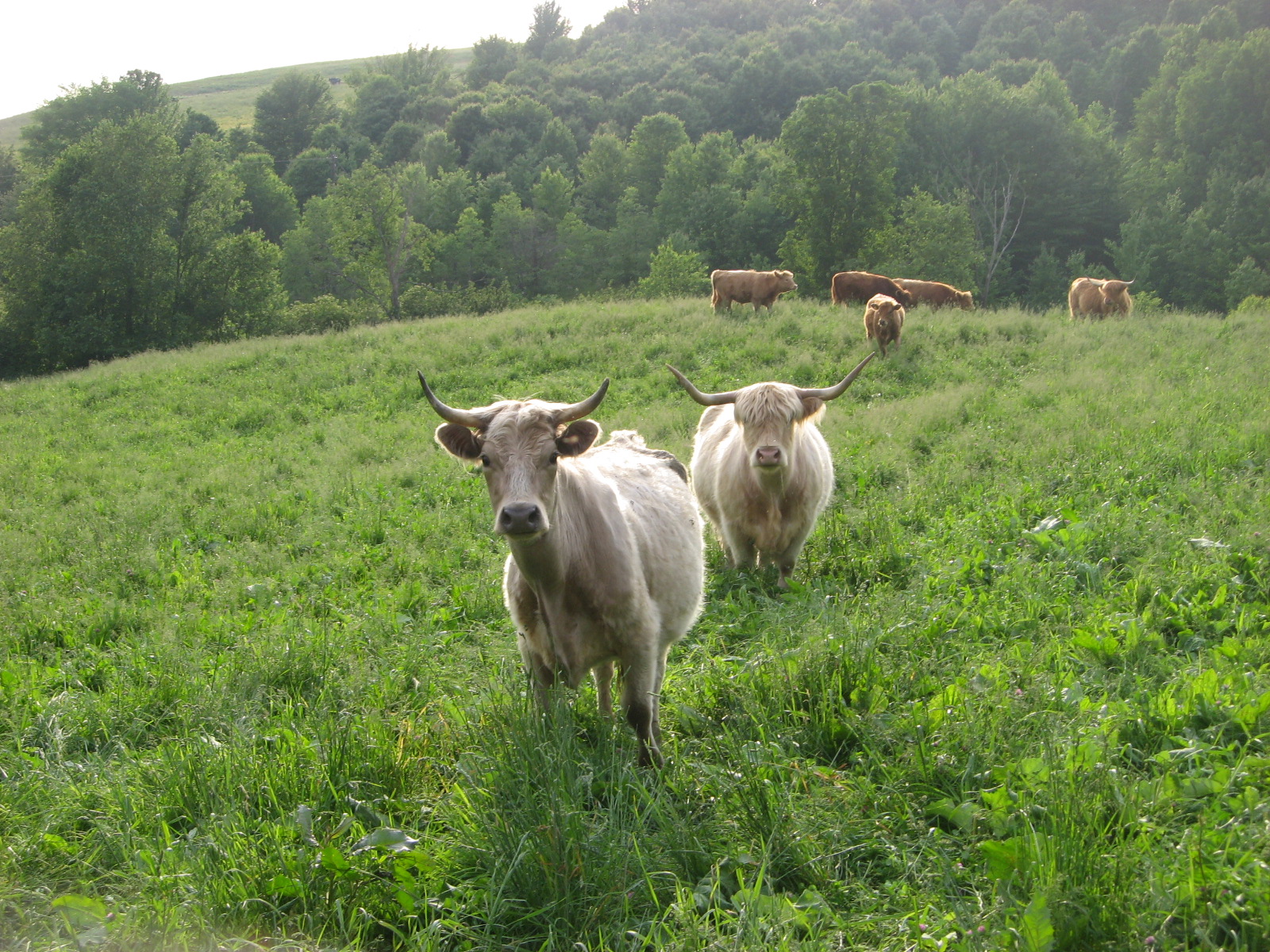
White Highlanders on Pasture

Raspberries in July

Catalina at Delaware County Fair. Moo!

Bluebird in our Garden


Riley home to visit Catalina


The Hen Party

Just Picked Tomatoes and Beans


Just Picked Wild Apples for the Press

Shane and Susannah Pressing Cider

The Cider Press

Morning Clouds over Mountain
The Turkey Slaughter Crew Day 1

Turkey Guts


Susannah Plucking Bronze Turkey

Susannah and Kate cut Christmas Tree down

Hauling the Tree Home

Merry Christmas and Happy New Year
The challenges of 2011 in both our home and business lives shape our outlook for 2012.  2011 was an important year for turning our energy inward to nurture and heal our family, to break or cement commitments and relationships, to question our judgments and actions, to adjust and make hard changes and to prioritize our goals and actions to attain happiness and sustainable success.   A heartfelt thank you to our family, friends and customers who provided us with the emotional and financial ballast to survive the many steps backwards in 2011 and who nudged and cheered us forward with promises of love and commitment.  A quick look into our crystal ball reveals renewed hope, happiness and success in 2012.  We hope to share it with you.
.


Tuesday, September 20, 2011

Summer turned into September

Dirty Hands are De Rigueur

I was handing over change to the check-out clerk at the supermarket the other day. She grabbed my outstretched hand and said admiringly, “You must be a farmer”. She then proceeded to tell me how her grandparents had a farm and how she wanted to buy a farm someday.

I was brought up to keep my nails and hands clean; dirty hands meant that you were god forbid, a laborer. Remember how Rhett Butler figured out that the green velvet curtain clad Scarlet O’Hara was lying about her life at Tara? He spotted her dirt creased hands and knew that the soft cheeked belle was actually working with her hands, a sure sign that she needed a cad to rescue her. While it is nice to be admired as a farmer, I could use a good rescuing now and then or perhaps another pair of dirty hands to share the load.


The Flood and What it means to the Unflooded

Areas along the Delaware and Susquehanna rivers suffered serious damage from Hurricane Irene and Lee. National news focused on the devastation in Margarettville, Prattsville, Binghamton and Wilksbarre. Federal and state relief efforts have been slow to assist towns and families struggling to rebuild so private flood relief efforts are emerging locally in the forms of  benefit concerts, events, private parties and auctions. The recent Raise the Roof Flood Relief effort organized by the Hamden Inn, Morgan George of Sherman Farmstead and the Watershed Agricultural Council was a great success raising more than $6,000 for flood stricken farmers. And it was a good reason to see friends and fellow farmers and share food, beer, music and stories, especially after a long, hard summer. The New York Times covered the event. Enough is enough at least for now. The flood relief publicity is killing our businesses. Farmers markets revenue have been down over 40% from last year. Local restaurants are serving only a handful of customers on the weekends and hotels and bed and breakfasts in the region are still unbooked for the upcoming holiday weekend. Why? Tourists and weekend home owners, after seeing news footage of some of our Catskill towns, are assuming that roads are closed, businesses have floated away and the landscape is littered with debris and mud. Most of our region was seriously unaffected by the floods. We lost power for five days and had to dry off our milking goat herd because hand milking was impossible without power. We lost a slew of turkey chicks because they did not survive the first night without heat lamps. But after a week, life returned to normal. Except our businesses.  Farmers are helping farmers by lending a skilled hand for farm work or offering to bring unscathed fall crops to the farmers markets, by loaning hay, helping with milking and lending farm machinery and tools. Instead of organizing a fundraiser why not encourage visitors, tourists, second home owners to return to the Catskills and support our farmers, stores, restaurants, hotels and events. Better yet - go to the farmers market this weekend and support the farmers who are supporting their fellow farmers.


First Frost

The first frost came precariously close to my herb and vegetable gardens. The frost line was one foot from the garden gate. I stopped weeding the garden two weeks ago and it is a disgrace, a wild tangle of weeds taller than my waist. Somewhere in the overgrowth are the potatoes, onions and beets. A good hard frost will kill the weeds and reveal where I planted them. The sun chokes were blown over by the Hurricane winds. So there is a natural hedge row of yellow flowers along the end of the garden. Since there are still ten jars of sun choke relish in the canning cupboards from last year, I may forego digging the tubers this year. I harvested the rugosa rose hips and made rose hip jam and sauce. The seeds inside the shell are coated with sliver like hairs and when digested, irritate the digestive tract. The aborigines called it itchy bottom disease. After reading that, I painstakingly cut and deseeded every rosehip that I harvested from four large rosa rugosas. After many hours of cutting, seeding, boiling, straining, jamming and canning, the harvest yielded four eight ounce jars of sauce. In terms of labor, they are worth an ingot of gold – little jars of rose gold. I will open one jar every month from January to April to help me get through winter.


The Creamery is Coming Up

After the excavation debacle, and then weeks of flooded post holes, we finally got the foundation and the perimiters up. Trusses and roof are next. The equipment is in storage or on hold until the building is up and weatherproofed. The barn raising date will be announced soon.  Our farmer friends Dave and Sonia gave us a gallon of sheep milk. I made a gallon of sheep milk yogurt in the picnic cooler.  The yogurt was thick and creamy and as Sonia described it, like white velvet.  We are fielding calls from people interested in learning how to make yogurt and ice cream.  Once we are up and running, the possibilities are endless. 


Turkey Time

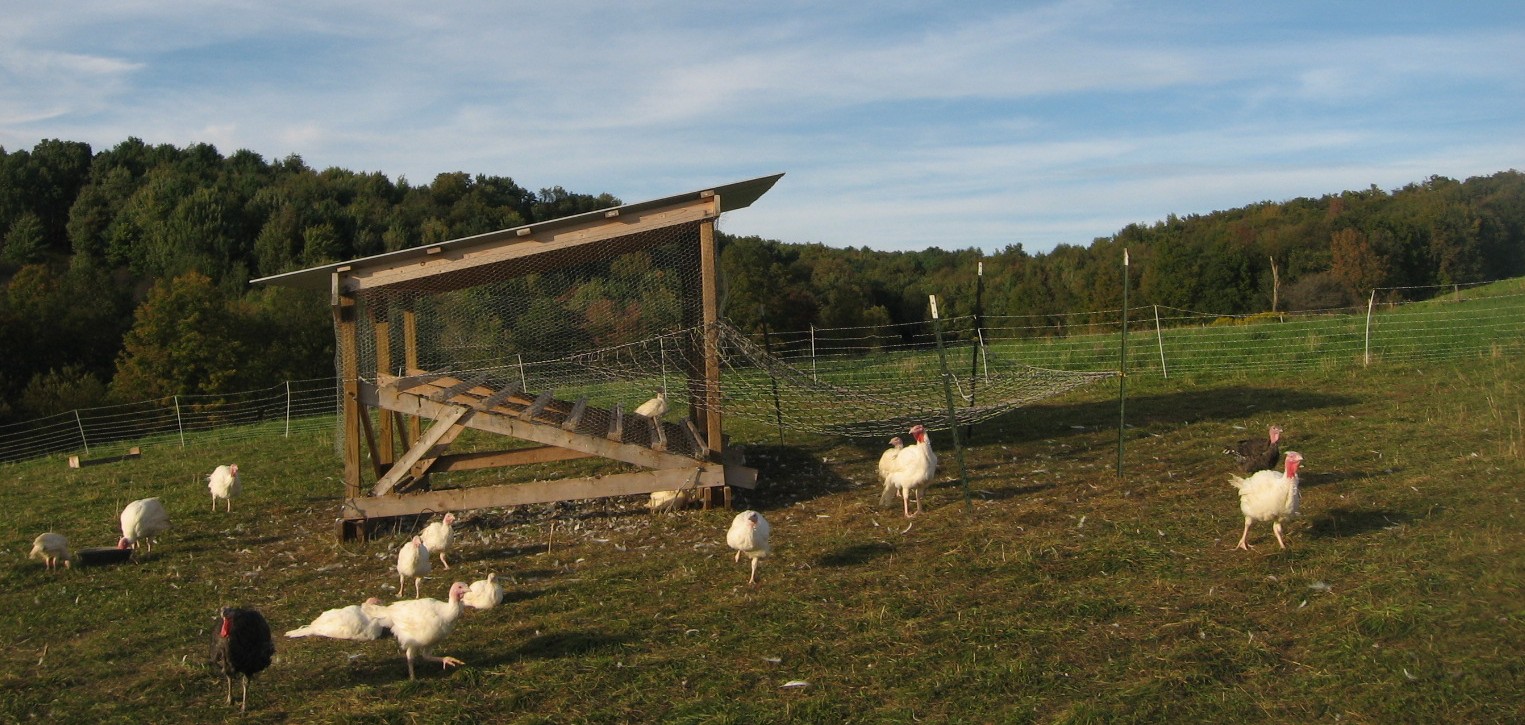
Because we lost most of the turkey chicks for the smaller size turkeys during the hurricane, we have a very limited amount of small size turkeys this year. So if you are looking for fifteen pounds or less, please order now. If the owls don’t stop picking them off, the larger turkeys will be in abundance this year. The owl net we attached to the roost seems to be fending off the owl predators. A reminder - we are usually sold out by the end of October so order early this year. Broad breasted bronzes or broad breasted whites are the breeds – the taste is the same – the bronzes have black pin feather marks on the skin and tend to be smaller.


Fable

The last brunch of the season will be held on Sunday October 11th. Only a couple of more weeks to join us this season for the farm tour and buffet brunch.  Dinners at Fable will continue as long as people continue to make reservations.  Last year, the last dinner of the season was the weekend before Thanksgiving. After Columbus Day, we bring in leather chairs, sofas and rugs and tuck the table up to the fireplace. The menu changes to hearty stews and soups and other seasonal fare that highlight the autumn harvest. The menu for the next two Saturdays is on our website at http://www.stoneandthistlefarm.com/fable.htm